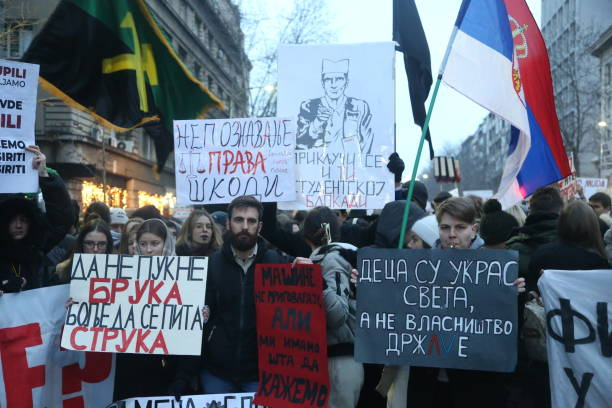
Serbia is experiencing its largest protest movement in history as student-led demonstrations against corruption intensify, putting increasing pressure on President Aleksandar Vučić. Tens of thousands of protesters have taken to the streets, blockading major infrastructure in response to government inaction over a deadly railway station collapse. The movement, which has spread across the country, is seen as both a rejection of state corruption and a broader challenge to Vučić’s increasingly authoritarian rule.
The protests erupted in November following the collapse of a concrete canopy at Novi Sad’s railway station, which killed 15 people. The tragedy, linked to poor construction standards in a government-backed infrastructure project carried out with a Chinese state consortium, has fueled public outrage. Critics argue that the project lacked transparency, with no public tenders and little regard for safety regulations.
“What we are seeing are the greatest street protests in the history of Serbia,” said Dejan Bagarić, a master’s student participating in the movement. “There’s never been anything like it. People are really animated because everybody has had enough of corruption, and this government is very corrupt.”
The protests have expanded beyond anger over the railway collapse, with citizens voicing their frustration over systemic corruption, high unemployment, and declining democratic freedoms under Vučić’s leadership. By last week, anti-government demonstrations had spread to over 100 cities, towns, and villages nationwide. In Belgrade, tens of thousands of students organized a 24-hour blockade of a major intersection, bypassing Serbia’s heavily state-controlled media through online organizing.
Human rights lawyer Čedomir Stojković, who filed a criminal complaint that forced the government to open an inquiry into the collapse, said the government’s reaction followed a familiar pattern. “Instead of taking responsibility, the government did what it always does—tried to cover it up,” he said. “But there’s a lot of solidarity, a lot of empathy for the students, and more and more people are coming out in support of them—professors, farmers, everyone.”
The protests have drawn comparisons to the 1990s demonstrations against Slobodan Milošević, the former Yugoslav strongman whose policies triggered the Balkan wars. Unlike previous anti-government movements, these protests are not led by opposition parties but rather by young Serbs who have only known Vučić’s leadership. Many of them were children when he took office eight years ago and are demanding real democratic change.
As the protests escalate, Vučić has responded with accusations that the demonstrators are part of a foreign-backed plot to destabilize the country. In a national address, he told Serbians: “Our country is under attack, from abroad and from inside.” His government has attempted to defuse tensions by declassifying documents related to the railway station collapse and even agreeing to meet some of the students’ demands. Last week, Vučić’s close ally, Prime Minister Miloš Vučević, resigned in an attempt to ease the pressure. However, few believe the protests will end anytime soon.
With youth unemployment at record levels and many graduates seeking opportunities abroad, there is a growing sense that Serbia’s younger generation has little to lose. To counter government crackdowns, the students have refused to appoint leaders, making decisions collectively in open plenary sessions.
“We are not choosing violence, and for now, the government is not choosing violence either,” said Bagarić from the protests in Novi Sad.
As the protests continue to swell, opposition leader Srđan Milivojević declared that Serbia’s young demonstrators are now shaping the country’s political future. “It’s irrelevant how the government reacts,” he said. “The students are dictating the tempo of the protests, and they will continue to do so until Vučić falls.”
With the movement gaining momentum, the coming weeks will determine whether Vučić can withstand Serbia’s largest-ever anti-government uprising or if the country is on the brink of historic political change.
Source: The Guardian